To find out whether ChatGPT knows your business, ask it directly: "What is [your business name]?" and "Who are the best [your service] providers in [your city]?" Repeat the same questions in Gemini and Perplexity, using a logged-out or temporary chat for a cleaner result. If you're missing or described wrongly, the fix comes down to five things: get indexed by Google, let AI crawlers in, add concrete facts and schema, keep your details consistent everywhere, and earn a few third-party mentions. The 30-day plan below walks through each one.
Try this right now, before you read another line. Open ChatGPT and type: "Who are the best [your service] providers in [your city]?" Then ask: "What is [your business name]?"
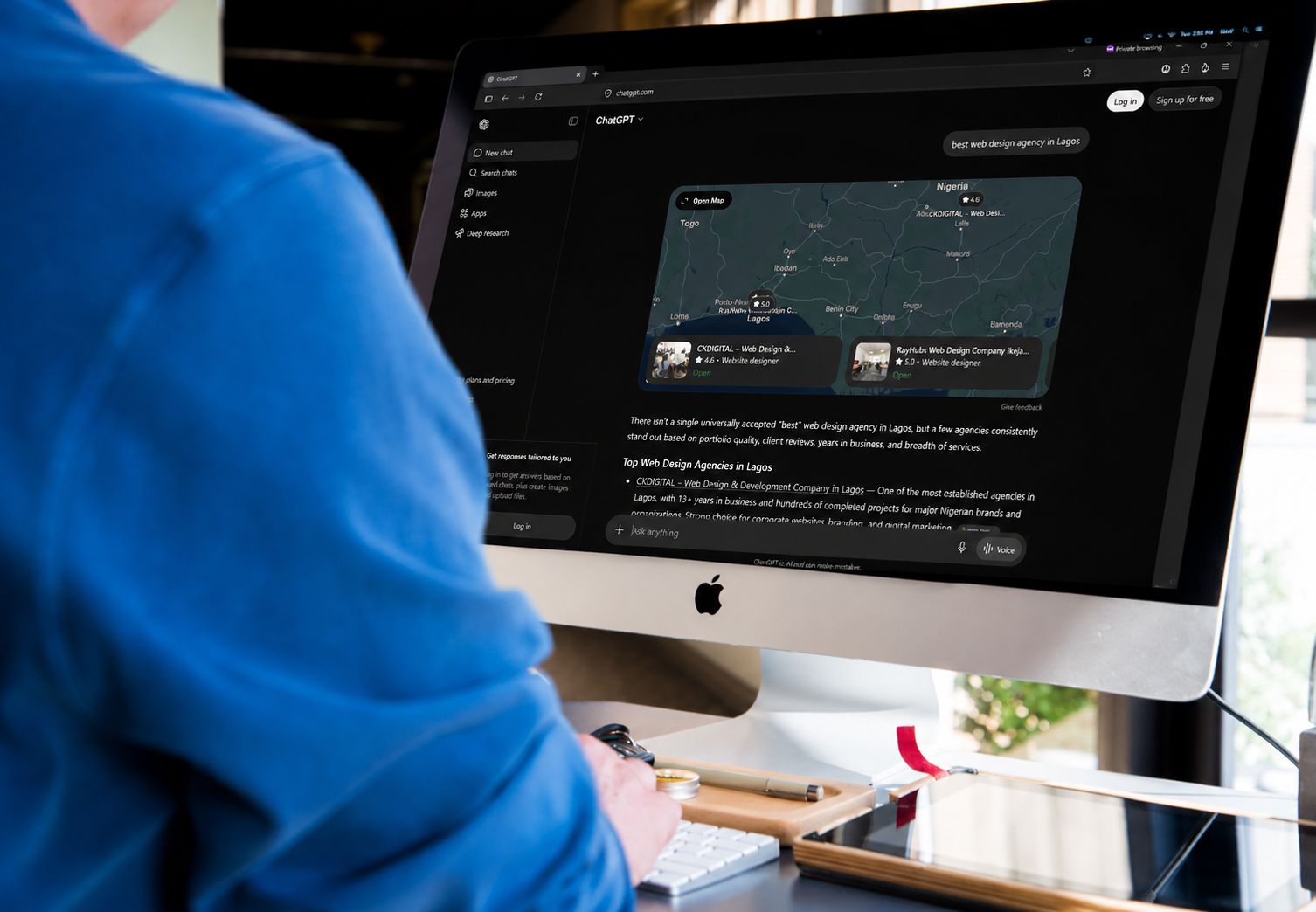
What came back? If you were missing from the first answer, or ChatGPT drew a blank on the second, that tells you something. To a growing number of your potential customers, your business effectively isn't there. And it's worse than being beaten by a competitor's ad. ChatGPT is handing them your competitor as the recommendation, in the trusted voice of an assistant they asked for help.
Why this matters more than it did last year
Search has quietly split in two. People still Google things. But a fast-growing number now ask an AI assistant instead, and they treat the answer the way you'd treat advice from a knowledgeable friend, not as a list of links to sift through. Three numbers show how far this has gone:
Put those together: almost half of an enormous, still-growing user base is asking for exactly the kind of recommendation that sends customers to businesses like yours. If you're not in those answers, that traffic flows to whoever is.
How to check what AI says about your business (5 minutes)
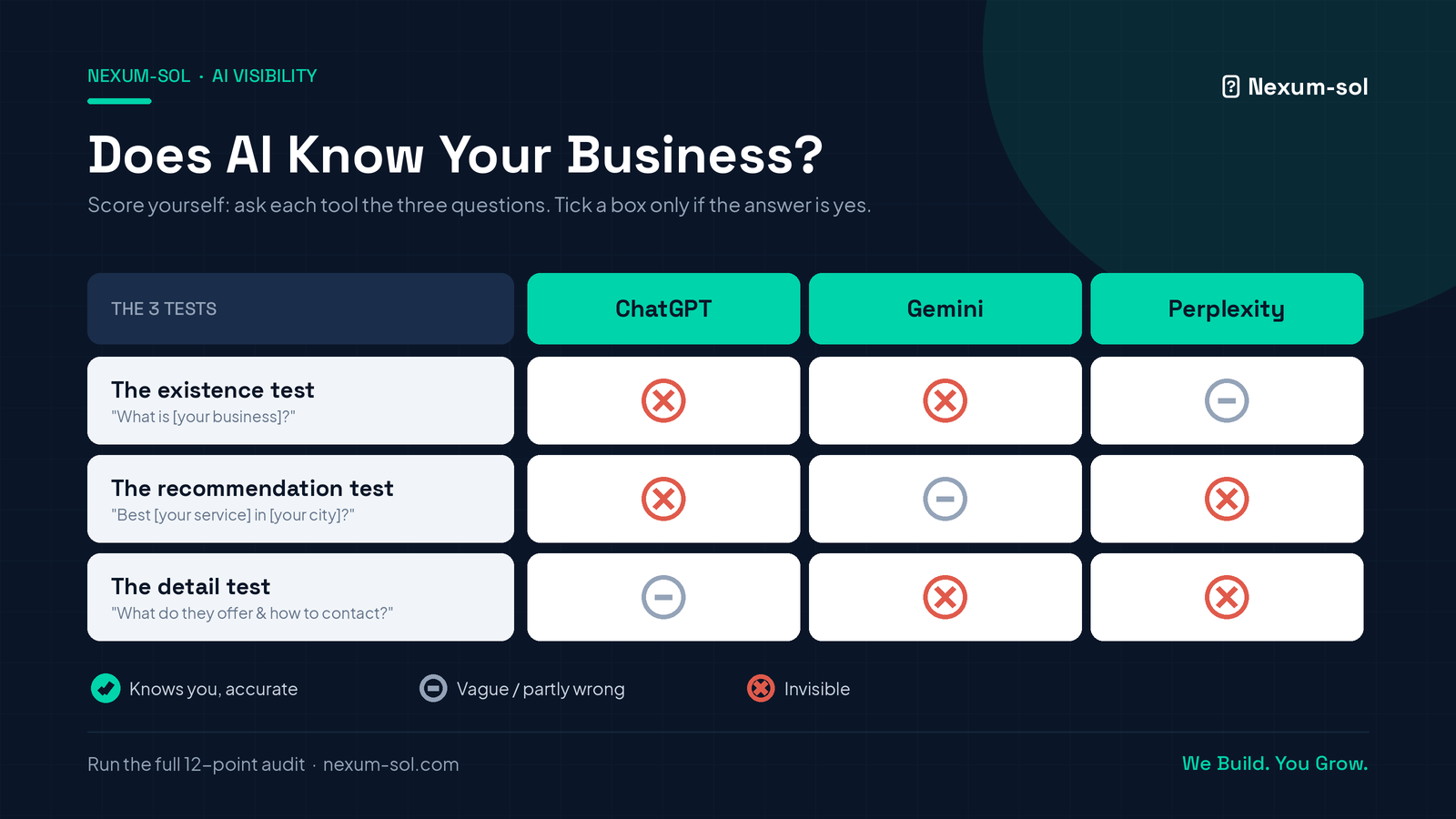
Don't guess. Test it. Run this quick check across the three tools your customers are most likely to reach for, asking each one the same questions:
- The existence test: "What is [your business name]?" Does it know you at all, and is what it says accurate and current?
- The recommendation test: "Who are the best [your service] providers in [your city]?" Do you appear? If not, who does?
- The detail test: "Tell me about [your business name], what do they offer and how do I contact them?" Are your services, location, and contact details right?
Run these in ChatGPT, Google Gemini, and Perplexity. A tip for a cleaner result: use a logged-out or temporary chat where possible, so the answer reflects what a stranger would see rather than something personalised to you. Write down, for each tool, whether you appeared and whether the information was correct.
Most small businesses, especially here in Nigeria, finish this test with the same uncomfortable result: AI either doesn't know them, or describes them vaguely and sometimes gets it plain wrong. That's good news, oddly enough. Your competitors are almost certainly in the same boat, so the first one to fix it gets a real head start.
Why doesn't ChatGPT know your business?
An AI assistant will only recommend a business it can find, make sense of, and confirm. When you're missing, the cause is usually one of these five gaps:
- Your site isn't well indexed. If Google barely sees your pages, the AI tools that browse the web can't find them either. We had to fix exactly this on our own site recently: verification, sitemap, canonical cleanup.
- You're blocking the AI crawlers. If your robots.txt disallows GPTBot, ClaudeBot, or PerplexityBot, those tools literally cannot read your site. Our llms.txt guide has the exact allow-list to use.
- Your content has nothing quotable. AI prefers pages with concrete facts (services, prices, location) over vague "we deliver excellence" copy.
- Your details are inconsistent. If your name, address, or phone differ across your site, Google Business Profile, and socials, AI can't confidently verify who you are.
- Nobody else mentions you. AI leans heavily on third-party sources like directories, reviews, and press. If the only place you exist online is your own site, there's no independent signal for it to trust.
Want the full check as a printable PDF?
Our free AI Visibility Audit turns this into a 12-point checklist, each with a 5-minute check and the exact fix. Straight to your inbox.
✓ Check your inbox, your checklist is on the way!
We respect your privacy. Unsubscribe at any time.
How to fix it: the 30-day version
You don't need to do everything at once. Work in this order, because each step builds the foundation for the next.
Week 1: get findable
Verify your site in Google Search Console, submit a sitemap, and make sure your pages are actually indexed. Confirm your robots.txt allows AI crawlers. This is the foundation: if AI can't reach you, nothing else matters.
Week 2: get understandable
Add LocalBusiness schema markup (your name, address, phone, services) so AI can confirm your details without guessing. Rewrite your key pages to state concrete facts: what you do, where, starting prices, turnaround. Then add an FAQ section answering the questions customers actually ask.
Week 3: get consistent
Make your business name, address, and phone number identical everywhere: website, Google Business Profile, Instagram, Facebook, LinkedIn, and any directories. Claim and complete your Google Business Profile if you haven't.
Week 4: get mentioned
Start building third-party signals. List in relevant directories, ask happy clients for reviews, and aim for one mention on a site that isn't yours: a local publication, a partner, an industry listing. It's the slowest of the four to pay off, and the one that moves the needle most.
For the deeper strategy behind all of this, see our pillar guide on SEO, AEO & GEO, and the plain-English breakdown of how those three layers differ.
Whatever ChatGPT says about your business today is what thousands of potential customers are being told. Here's the encouraging part: most businesses are invisible to AI right now. Get the fundamentals right and you don't just catch up, you pull ahead. Run the 5-minute test, then work the 30-day plan.
Frequently asked questions
How do I check if ChatGPT knows my business?
Open ChatGPT and ask three things directly: "What is [your business name]?", "Who are the best [your service] providers in [your city]?", and "Tell me about [your business name]." Repeat in Gemini and Perplexity. Note whether you appear and whether details are accurate. Use a logged-out or temporary chat for a cleaner, unpersonalised result.
Why doesn't ChatGPT mention my business?
Usually because AI has little trustworthy information to draw on: your site isn't well indexed, your robots.txt blocks AI crawlers, your pages lack concrete facts and schema, your details are inconsistent across the web, or no third-party sites mention you. AI recommends what it can find, understand, and verify.
Does ChatGPT use Google to find businesses?
Partly. ChatGPT answers from a mix of training data and live web search for current queries. When it browses, it pulls from indexed, crawlable pages, so an indexed site with strong SEO directly improves your chances of being found and cited, alongside third-party mentions like directories and reviews.
How long does it take to get my business into ChatGPT's answers?
For tools that browse the live web (ChatGPT Search, Perplexity, Gemini), well-structured content can be cited within days to a few weeks of being indexed. Information baked into training data takes months, which is why consistent third-party mentions and fresh, factual content matter.
Can I pay to appear in ChatGPT?
Not for organic recommendations. ChatGPT's recommendations aren't paid placements. OpenAI has a merchant program for product feeds in shopping contexts, but for service businesses the path is earned: an indexed site, structured data, consistent listings, factual content, and third-party mentions.
Is it worth optimizing for ChatGPT if I'm a small local business?
Yes, arguably more so. Half of ChatGPT use is people seeking recommendations, and very few small businesses (especially in Nigeria) have optimized for AI search. That low competition means getting the fundamentals right can make you the business AI recommends for your category, often faster and cheaper than ranking #1 on Google.
References & sources
- Reuters, ChatGPT weekly active users (June 2026), via ChatGPT Statistics 2026, Panto AI
- OpenAI, usage analysis of 1.5 million conversations (49% "Asking"), via ChatGPT Statistics 2026, Arvow
- AI platform referral traffic share (~82% from ChatGPT), via 50 ChatGPT Statistics for 2026, AI Business Weekly
- Consumer preference for AI over traditional search for recommendations, via ChatGPT Statistics, Master of Code
- Google Search Central, Robots.txt Introduction
References & sources
- OpenAI, ChatGPT weekly active user announcements, via AI Search Statistics 2025-2026, Omnibound
- Conductor, 2026 AI Overview Benchmarks and Superlines, citation & freshness research, via AI Search Statistics 2026, Superlines
- Muck Rack, earned media share of AI citations (May 2026), via AI Search Statistics 2026, Reporter Outreach
- Adobe Digital Insights, AI referral traffic & conversion analysis (January 2026), via Omnibound
- Google Search Central, Robots.txt Introduction and Guide
- Schema.org, Schema Markup Validator